
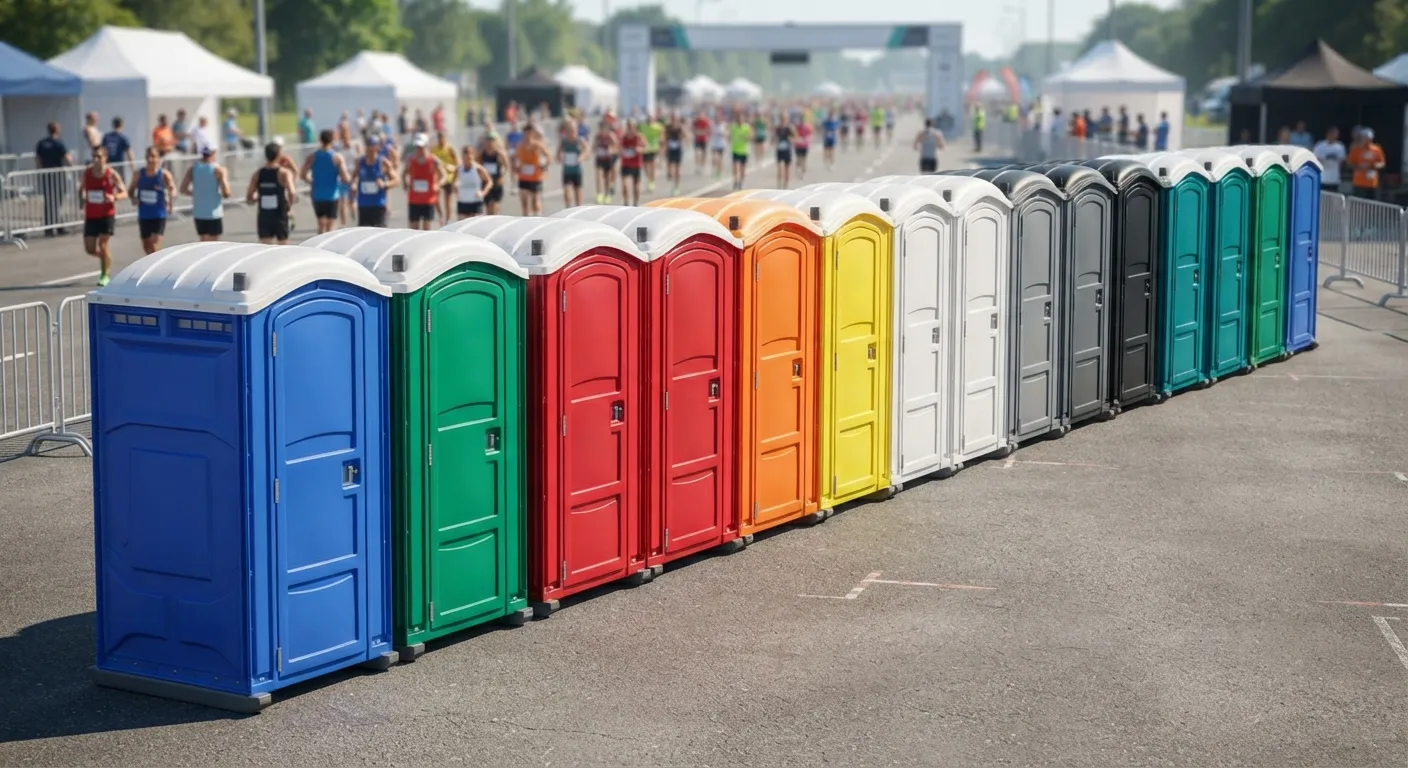
How many porta potties does a marathon actually need?
Start with the crowd, then split it by location. A 5K with 300 runners and 200 spectators needs units at the start/finish area and maybe one water-stop cluster if the course loops back. A full marathon with an out-and-back or point-to-point route needs restrooms staged every few miles, because runners cannot backtrack. OSHA 1926.51(c) sets construction-site ratios, but race organizers in Burbank generally use it as a starting benchmark: 1 toilet per 20 people for smaller staging areas, scaling to 1 per 40 as headcount climbs past 20. For a clearer breakdown by group size, our porta potty calculator guide walks through the math event by event. Standard units run $130 to $500 for a week rental, which covers most single-day races when you add a day-of service call. Spectator zones near the finish line fill fast, so plan extra units there, not just at the start. Burbank Porta Pros builds race routes around cluster spacing first and total headcount second, because a runner who has to leave the course to find a bathroom half a mile away is a bigger problem than a slightly long line.
| unit | duration | low | typical | high |
|---|---|---|---|---|
| standard | day | 100 | 150 | 350 |
| standard | weekend | 125 | 250 | 400 |
| ada | day | 200 | 230 | 400 |
| deluxe | day | 85 | 300 | 1200 |
For races with VIP tents or a runner's village, a deluxe flushable unit or a small restroom trailer handles sponsor hospitality without mixing that crowd into the general runner line. A 2 stall restroom trailer fits most finish-line VIP areas without eating too much staging space.
What else does a race site in Burbank need besides restrooms?
Restrooms are the anchor, but a full race footprint usually needs handwashing, barriers, and power. 29 CFR 1910.141(d)(2) requires soap and towels or a hand-drying device at washing stations, since hand sanitizer alone does not meet that standard, so pair every restroom cluster with a handwashing station or a portable sink near any food or medical tent. Course marshals and finish-chute staff often ask about crowd control too. Temporary fencing or crowd control barrier rental keeps spectators off the runner lane at the start and finish, and barricades used for that purpose should meet ANSI D6.1 per OSHA 1926.202. Early-morning races in Burbank often start before sunrise, so a light tower at the staging area helps volunteers set up units and signage safely.
If your race needs power for timing equipment, PA systems, or a medical tent, ask about a temporary power pole rather than running extension cords across a public path. How to brace a temporary power pole matters here: the pole needs a stable base, guy-wires or a braced frame rated for wind load, and clearance from the restroom cluster and any barrier line, since a pole that shifts mid-race can knock over signage or block a route. Grounding and GFCI protection still apply per OSHA 1926.404(b)(1)(ii) even on a temporary event circuit. Placement of the pole, the restrooms, and the fencing should all get planned together, not bolted on separately the week of the race.
Do I need a permit for race-day portable restrooms in Burbank?
Placement in the public right of way needs confirming with the city of Burbank before delivery, since permit rules vary by route and by street closure plan. Most race organizers coordinate that permit alongside their street closure application, and the porta potty permit requirements page walks through what questions to ask the city. If your course runs near West Hollywood, about 10.2 miles south of Burbank, or crosses jurisdiction lines toward Beverly Hills, 12.0 miles southwest, you may need separate sign-off from each city along the route. Burbank Porta Pros coordinates delivery timing around your permit window so units are staged before road closures go into effect, not after.
How far in advance should I book restrooms for a race?
Book 4 to 6 weeks out for a race over 300 participants, sooner if your date lands on a busy spring or fall weekend. Smaller races under 200 people can often book 2 to 3 weeks out. Waiting until race week limits unit selection and cluster placement options.
Can I place restrooms directly on the race course?
Yes, but keep a 36 inch clear path per ADA Standards section 403.5.1 so units do not block the running lane or wheelchair route. Stage clusters just off-course at aid stations instead of directly in the path.
How many ADA units do I need for a race?
At least one accessible unit per cluster location, per ADA Standards section 213.2. A race with four cluster points along the route needs four ADA units minimum, not one for the whole course.
What if my race runs into the evening?
Ask about a light tower for the finish area and any restroom cluster used after dark. OSHA 1926.56(a) sets minimum illumination levels relevant to construction, and race organizers use it as a practical guide for evening event lighting too.
Do runners need handwashing stations too?
Yes, especially near hydration and food stations. Pair each restroom cluster with a handwashing station so runners and volunteers can wash before eating, not just after using the restroom.
Next step
Get a delivery date
Tell us the address, the dates and the headcount. We size the order and confirm the route.